

Professional Certificate in Machine Learning and Artificial Intelligence
Apply AI and ML with clarity, confidence and impact
This 25-week online programme delivers a rigorous, world-class learning experience led by leading experts. Beyond developing technical expertise, it sharpens your ability to evaluate trade-offs, anticipate where models may fail, and clearly communicate decisions to non-technical stakeholders. With a strong blend of technical depth and business context, along with foundational exposure to generative AI and large language models (LLMs), the programme equips you to apply ML responsibly and confidently unlock new career opportunities in the field.
11million
£61,000
Key takeaways
The programme covers cutting-edge skills and organisational strategy in ML and AI. It will enable you to:
Evaluate the feasibility of machine learning solutions for specific business challenges.
Determine the appropriate machine learning methods to improve predictive performance and decision-making strategies.
Analyse the real-world implications of artificial intelligence.
Analyse complex datasets using machine learning to improve organisational performance.
Refine machine learning models using Python to enhance performance metrics.
Evaluate the feasibility of probabilistic and statistical techniques in addressing data.
Examine generative AI principles and the mechanics of LLMs.
Analyse how to scale, optimise, and apply generative AI models across real-world business scenarios.
Testimonials
Tools and platforms used in the programme






What you will learn
Module 0: Programme Orientation and Programming Tools
Understand the programme structure, core competencies and learning resources for the Professional Certificate in Machine Learning and Artificial Intelligence. Meet the four faculty members through an overview video, and explore the topics they will cover.
Refresh essential Python concepts through short videos. Learn to navigate EMCodE and Google Colab using step-by-step guides, practice exercises and troubleshooting tips.
Module 1: Maths Concepts in ML/AI
Develop the foundational mathematical knowledge essential for understanding ML and AI.
Apply linear algebra concepts — specifically vectors, matrices, transformations and eigenvalues — to solve mathematical problems in ML/AI.
Analyse key calculus concepts — specifically derivatives, partial differentiation, chain rule and norms.
Analyse key optimisation concepts, including gradient descent, local minimum and global minimum and learning rate.
Apply optimisation techniques in Python.
Examine the foundational mathematical concepts in ML and AI.
Module 2: Introduction to ML
Gain a solid foundation in core ML concepts and learn to apply them to real-world organisational problems.
Analyse the basics of ML, including key concepts such as variable classification, forecasting versus inference and the differences between ML and statistics.
Examine the major dividing lines in the ML landscape, including supervised vs unsupervised learning, prediction vs classification, parametric vs non-parametric approaches and the ML process.
Implement techniques to handle missing data in Python and learn the initial steps of the ML process.
Assess whether ML is the right solution for specific organisational challenges and apply it to industry problems.
Module 3: Probability for ML
Learn key probability concepts and their applications to machine learning challenges.
Examine core probability principles and their practical applications.
Differentiate between probability and statistics in data analysis.
Apply probability models, including fair fair and biased coins, to real-world scenarios.
Analyse independent and dependent variables and their impacts on calculations.
Run Monte Carlo simulation to demonstrate probability principles.
Implement Bayes' rule and total probability in decision-making contexts.
Analyse probability distributions and their importance in ML.
Module 4: Statistics for ML
Learn essential statistical methods and how they support data-driven decision-making in ML.
Analyse how statistics are used in real-world ML applications.
Calculate measures such as mean, median and standard deviation and detect data outliers.
Perform maximum likelihood estimation and analyse data relationships using regression and coefficients.
Visualise data with scatterplots and interpret variable correlations.
Evaluate statistical estimations using bootstrapping techniques.
Module 5: Generalisation Theory and the Bias–Variance Trade-Off
Refine ML models that balance accuracy and generalisation.
Examine how sample size impacts model accuracy and predictions.
Evaluate different models and determine the most suitable one for specific data sets.
Analyse the role of training, validation and test sets in model selection.
Apply Laplace's rule of succession to compute probabilities.
Assess the feasibility of ML for real-world problems through data analysis.
Module 6: Basics of Predictive Performance Evaluation
Develop analytical skills to evaluate the performance of ML models.
Measure regression and classification performance using accuracy, sensitivity and specificity.
Implement confusion matrices in Python to assess classification models.
Use lift charts and ranking techniques to evaluate predictive models.
Summarise model performance metrics for different types of output variables.
Examine real-world applications of performance evaluation through competitions.
Module 7: Advanced Predictive Performance Evaluation
Enhance predictive performance evaluation with advanced techniques.
Apply stratified sampling to balance class distributions in data sets.
Use oversampling techniques to improve classification model performance.
Evaluate predictive performance using k-fold cross-validation in Python.
Combine predictive techniques to enhance model accuracy across industries.
Module 8: Nearest Neighbour Methods
Explore how k-nearest neighbour (KNN) methods support classification and regression.
Analyse KNN applications and calculate distance norms.
Examine how predictors influence classifier performance.
Apply normalisation techniques and differentiate categorical predictors.
Evaluate decision boundaries and choose optimal k values for performance.
Use KNN for classification and regression, optimising model performance.
Module 9: Decision Trees: Part One
Learn the fundamentals of decision trees for data-driven decision-making.
Evaluate decision tree models.
Calculate information gain using entropy and the Gini index.
Identify optimal data-splitting techniques to improve model accuracy.
Build decision tree models in Python.
Examine strategies to prevent organisational churn using decision trees.
Module 10: Decision Trees: Part Two
Advance your knowledge of decision trees and ensemble techniques.
Determine optimal tree depth for accurate predictions.
Enhance model accuracy using bagging, random forests and boosting techniques in Python.
Evaluate real-world applications of tree-based models.
Compare decision trees and KNN methods to choose the best approach for specific problems.
Analyse model interpretability and fairness in ML.
Module 11: Naïve Bayes
Explore the Naïve Bayes classifier and its practical applications.
Identify when to use Naïve Bayes for decision-making.
Apply Bayes's theorem and Naïve Bayes classifiers for predictions.
Evaluate the strengths and limitations of the Naïve Bayes approach.
Convert numerical data into categorical formats for improved model performance.
Examine real-world applications of Naïve Bayes across industries.
Module 12: Bayesian Optimisation
Optimise ML models using Bayesian techniques.
Use Python to fine-tune models and improve performance metrics.
Analyse parameter tuning and its relationship to surrogate models.
Balance exploration and exploitation in Gaussian processes.
Determine the right time to stop tuning for optimal performance.
Apply Bayesian optimisation to industry-specific challenges.
Module 13: Logistic Regression
Explore logistic regression and its role in classification problems.
Compare linear and logistic regression to understand their applications.
Adjust parameters to optimise logistic regression models.
Identify significant input variables using z-scores and p-values.
Optimise logistic functions to enhance model performance.
Evaluate the advantages and trade-offs of logistic regression compared with other methods.
Module 14: Support Vector Machines
Master the fundamentals of support vector machines (SVMs) and their real-world applications.
Select optimal hyperplanes to improve decision-making and classification accuracy.
Examine the differences between hard-margin and soft-margin SVMs and apply them to data sets with outliers.
Choose and implement the appropriate kernel type for different ML problems.
Apply SVMs in Python for high-dimensional data and multi-class classification.
Analyse real-world use cases of SVMs in organisational problem-solving.
Module 15: Neural Networks and Deep Learning: Part One: Introduction
Build a strong foundation in neural networks and their optimisation techniques.
Analyse how neural networks approximate continuous functions to improve predictive performance.
Develop effective neural network models for practical applications.
Examine the fundamentals of gradient descent and its role in model optimisation.
Apply backpropagation techniques to enhance network training efficiency.
Select appropriate optimisation methods to improve network performance.
Module 16: Neural Networks and Deep Learning: Part Two: Advanced Concepts
Explore advanced deep learning techniques and their applications.
Analyse the five core building blocks of deep learning.
Choose the right coding libraries and packages for deep learning projects.
Construct neural networks and define effective decision boundaries.
Assess the feasibility of deep learning for solving organisational challenges.
Module 17: Neural Networks and Deep Learning: Part Three: Convolutional Neural Networks
Examine convolutional neural networks (CNN) architectures and their role in image recognition and beyond.
Examine the biological inspiration and filtering operations behind CNNs.
Analyse popular CNN architectures, including LeNet-5.
Customise CNN models using PyTorch.
Apply CNNs to real-world organisational problems and assess their performance.
Module 18: Hyperparameters and Hyperparameter Tuning
Optimise ML models by understanding hyperparameter tuning techniques.
Analyse the role of hyperparameters in model performance.
Evaluate different methods for tuning hyperparameters and their effectiveness.
Apply hyperparameter tuning techniques to address specific organisational challenges.
Examine emerging techniques and future applications in hyperparameter optimisation.
Modules 19: Foundations of Generative AI and Large Language Models
Learn key concepts in generative Al and large language models (LLMs) and their practical significance.
Analyse the ability to understand language between humans and machines using historical and contemporary examples.
Analyse the implications of different model sizes in relation to performance, accessibility and global Al development trends.
Apply the concept of emergence to prompt engineering.
Analyse how transformers work in relation to attention, parameter settings and model behaviour.
Calculate hyperparameter sensitivity in the context of large language models.
Analyse the impact of hyperparameter tuning on training time and scalability.
Calculate the total attention comparisons in relation to model complexity.
Analyse foundational LLM concepts, including emergence, transformer, hyperparameter tuning and attention.
Explain how LLMs work, including their architecture, scale, training dynamics and emergent capabilities.
Module 20: Advanced Generative AI and Large Language Models
Explore key technical considerations in scaling, optimising and applying LLMs across real-world contexts.
Evaluate scaling strategies and hyperparameter tuning in relation to performance, cost and robustness.
Examine the practical implications of emergence thresholds in relation to task-specific performance.
Analyse the real-world value of few-shot learning in accelerating model training and deployment across different industries.
Evaluate the risks of scaling LLMs in the context of emergence.
Analyse the benefits of building a transformer from scratch in comparison to using prebuilt models.
Analyse the foundational components of a transformer in relation to model structure.
Refine a transformer in PyTorch based on changes to architecture.
Analyse advanced LLM concepts in relation to scaling, emergence and transformer components.
Module 21: Transparency and Interpretability
Understand how transparency and interpretability support responsible and ethical machine learning decisions.
Examine the role of transparency in building trust, fairness and accountability.
Identify bias in data and machine learning models.
Apply documentation practices, including datasheets and model cards.
Evaluate trade-offs between explainability, accuracy and fairness.
Build interpretable models, including decision trees.
Assess ethical implications alongside performance metrics.
Module 22: Unsupervised Learning: Part One – Clustering Techniques
Uncover hidden patterns in data using clustering methods.
Differentiate between single data points and data clusters.
Implement hierarchical clustering and k-means clustering in Python.
Evaluate the strengths and limitations of clustering analysis.
Apply clustering techniques to real-world organisational scenarios.
Module 23: Unsupervised Learning: Part Two – Principal Component Analysis
Reduce data dimensionality while retaining key information.
Identify principal components that capture data variance.
Determine the optimal number of components for effective dimensionality reduction.
Apply principal component analysis (PCA) techniques using Python to real-world data sets.
Explore practical applications of PCA in ML.
Module 24: Reinforcement Learning
Learn decision-making strategies inspired by human behaviour and trial-and-error learning.
Analyse the fundamentals of reinforcement learning and its real-world applications.
Develop solutions for multi-armed bandit problems in Python.
Apply Markov decision processes and Q-learning for optimal decision-making.
Explore reinforcement learning applications across industries.
Module 25: Capstone Project: Black-Box Optimisation
Apply your machine learning skills to a realistic challenge by iteratively improving a model in a simulated black-box environment. This capstone runs throughout the programme and culminates in a portfolio-ready GitHub project that demonstrates your ability to tackle complex, real-world ML problems.
Case studies

NETFLIX

ZILLOW

DHL

Deutsche Telekom

Alibaba Group

IBM Watson
Programme experience

Job-ready ML/AI skills in a high-demand field

Real-world insights from Imperial Executive Education faculty and industry experts

A hands-on capstone project to share with potential employers

A verified digital certificate of completion from Imperial Executive Education

Associate alumni status from Imperial Executive Education on programme completion

Explore applications of generative AI (GenAI)
Career preparation and guidance
Breaking into the field of ML and AI requires a precise combination of technical knowledge and business acumen. Our programme will guide you in developing a career path by assisting you in crafting your elevator pitch and sharpening your interview skills. These services are provided by Emeritus, our learning collaborator for the programme. The support team includes programme leaders and career coaches who will help you reach your learning goals and navigate your job search. The primary goal is to equip you with the skills needed to prepare for a career in ML and AI. However, we do not guarantee a job placement.
Emeritus offers assistance with the following career services:
Live career coaching and open Q&A sessions, resume feedback, mock interviews and career development exercises
A birds's-eye view of the current job market landscape and five-year market trajectory
Assistance in crafting your elevator pitch and preparing for job interviews
Insights on negotiating your salary and opportunity to network with global peers and instructors
Insights into key industry players, latest trends and industry-specific interviews
Note: Learners will have access to up to 3 individualised career coaching sessions as an integral part of the programme. Additional sessions may be requested based on demonstrated progress and alignment with the learner’s professional goals.
Programme faculty

PROFESSOR WOLFRAM WIESEMANN
Professor of Analytics and Operations; Head of the Analytics, Marketing and Operations Department; Fellow, Imperial Business Analytics Centre Operations Management Department, Imperial College London
Wolfram Wiesemann is a Professor of Analytics and Operations as well as the head of the Analytics, Marketing and Operations department at Imperial Executive Education. In addi...

PROFESSOR RUTH MISENER
Professor, Computational Optimisation Department of Computing, Imperial College London
Ruth Misener is a Professor of Computational Optimisation in the Department of Computing at Imperial College London. Her research focuses on numerical optimisation algorithms ...

DR ALEX RIBEIRO-CASTRO
Data Scientist, Senior Teaching Fellow Operations Management Department, Imperial College London
Dr Alex Ribeiro-Castro is a Data Scientist and Senior Teaching Fellow with the Operations Management Department at Imperial Executive Education. He also teaches in the Global ...

PROFESSOR CHRISTOPHER TUCCI
Professor, Digital Strategy and Innovation Imperial Executive Education
Christopher Tucci is a Professor of Digital Strategy and Innovation at Imperial Executive Education. Professor Tucci’s teaching focuses on design thinking, digital strategy an...
Become an associate alumni
Take your partnership with Imperial Executive Education to the next level by becoming an associate alumnus. Complete the programme to claim your associate alumni status and join our active community.
Certificate
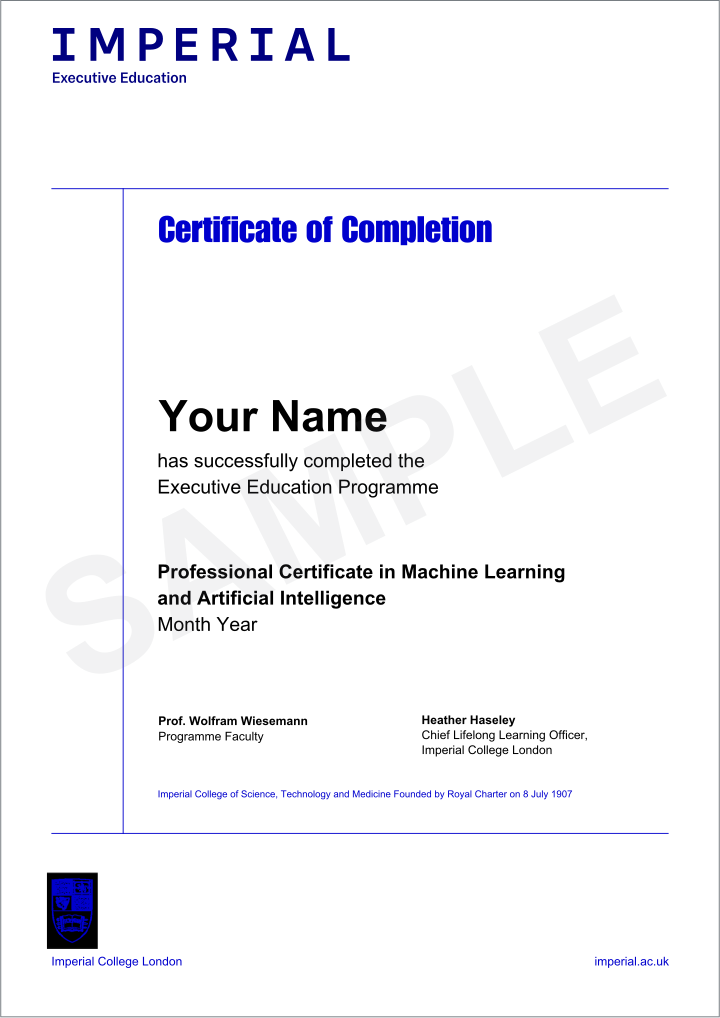
Upon completion of the programme, participants will be awarded a verified digital certificate by Imperial Executive Education and the Imperial College London Department of Computing.
Note: You will earn the Associate Alumni status upon successful completion of the programme. Visit the Associate Alumni page to find out more.
FAQs
The programme
How do I know if this programme is right for me?
After reviewing the information on the programme landing page, we recommend you submit the short form above to gain access to the programme brochure, which includes more in-depth information. If you still have questions on whether this programme is a good fit for you, please email learner.success@emeritus.org, and a dedicated programme adviser will follow up with you very shortly.
Are there any prerequisites for this programme?
Some programmes do have prerequisites, particularly the more technical ones. This information will be noted on the programme landing page, as well as in the programme brochure. If you are uncertain about programme prerequisites and your capabilities, please email us at learner.success@emeritus.org for assistance.
What are the requirements to earn a certificate?
This is a graded programme. You will be required to complete a combination of individual assignments, quizzes and a final project. Each component carries a certain number of points, and a cumulative score of 75 per cent is required to pass and obtain your professional certificate.
Will I be guaranteed a job upon completion of the programme?
The primary objective of this programme is to give you the skills you need to be prepared for a job in this field. While eligible participants will receive career coaching and support and may receive introductions to our hiring partners, job placement is not guaranteed.
The learning experience
How much time will I be expected to devote to this programme?
Each programme includes an estimated learner effort per week. This is referenced at the top of the programme landing page under the Duration section, as well as in the programme brochure, which you can obtain by submitting the short form at the top of this web page.
How will I spend my time in this programme?
You will divide your learning time between viewing recorded coding demos, video lectures, contributing to class discussions, completing assignments, projects and knowledge checks and attending optional live sessions with industry experts and programme leaders.
How is the programme administered? Can the programme be accessed anytime?
The programme is accessed through the custom learning portal. This portal will give you access to all programme-related content such as video lectures, assignments and discussions. Live office hours will be conducted using a webinar tool. The video lectures and assignments are accessible weekly throughout the programme. In the event you miss a live session, a recording will be made available.
Do I need to attend live sessions every week?
Faculty video lectures are recorded, allowing you to watch these on your own schedule. However, participation in optional live sessions and discussion boards is highly encouraged. Live sessions will give you the opportunity to draw on the coding experience of our industry-experienced programme leaders to answer your questions and help reach your learning goals. The discussion boards are also an integral part of the learning experience, giving you and your peers the opportunity to learn together, along with guidance from the moderators.
Can I download the programme videos?
You can download video transcripts, assignment templates, readings etc. However, the video lectures are only available for streaming and require an internet connection.
How do I interact with other programme participants?
You can communicate with other participants through our learning platform. You will be able to form groups based on your interests and location. A direct messaging feature is also available through the platform.
What is it like to learn online with the learning collaborator, Emeritus?
More than 350,000 individuals across more than 80 countries have chosen to advance their skills with Emeritus and its educational learning partners. In fact, 90 per cent of the respondents of a recent survey across all our programmes said that their learning outcomes were met or exceeded. All the contents of the course would be made available to students at the commencement of the programme. However, to ensure the programme delivers the desired learning outcomes, the students may appoint Emeritus to manage the delivery of the programme in a cohort-based manner, the cost of which is already included in the overall programme fee of the course. A dedicated programme support team is available 24/5 (Monday to Friday) to answer questions about the learning platform, technical issues or anything else that may affect your learning experience.
Certification
What are the requirements to earn the certificate?
Each programme includes an estimated learner effort per week, so you can gauge what will be required before you enrol. This is referenced at the top of the programme landing page under the Duration section, as well as in the programme brochure, which you can obtain by submitting the short form at the top of this web page. All programmes are designed to fit into your working life. This programme is scored as a pass or no pass; participants must complete the required activities to pass and obtain the certificate of completion. Some programmes include a final project submission or other assignments to obtain passing status. This information will be noted in the programme brochure. Please contact us at learner.success@emeritus.org if you need further clarification on any specific programme requirements.
What type of certificate will I receive?
Upon successful completion of the programme, you will receive a smart digital certificate. The smart digital certificate can be shared with friends, family, schools or potential employers. You can use it on your cover letter, resume and/or display it on your LinkedIn profile. The digital certificate will be sent approximately two weeks after the programme, once grading is complete.
Can I get the hard copy of the certificate?
No, only verified digital certificates will be issued upon successful completion. This allows you to share your credentials on social platforms such as LinkedIn, Facebook and X.
Do I receive alumni status after completing this programme?
No, there is no alumni status granted for this programme. In some cases, there are credits that count towards a higher level of certification. This information will be clearly noted in the programme brochure.
How long will I have access to the learning materials?
You will have access to the learning platform and all programme materials (videos excluded) for 24 months following the programme start date. Access to the learning platform is restricted to registered participants per the terms of agreement.
Technical requirements
What equipment is needed, or what are the technical requirements for this programme?
To successfully complete this programme online, you must have access to a device meeting the minimum requirements, found here. In addition, Microsoft Office or similar product and a PDF viewer are required to access documents, spreadsheets, presentations, PDF files and transcripts in all programmes. Please check the learning platform on the first day of class.
Do I need to be online to access the programme content?
Yes, the learning platform is accessed via the internet, and video content is not available for download. You can download files of video transcripts, assignment templates, readings etc. Video lectures must be streamed via the internet, and webinars and small group sessions will require an internet connection.
Payment process
What is the programme fee for the programme, and what forms of payment do you accept?
The programme fee is shown at the top of this page.
Flexible payment options, group enrolment benefits and a referral bonus are available.
Tuition assistance may be available for participants who qualify. Please contact your programme adviser to discuss.
What if I don’t have a credit card – is there another mode of payment accepted?
Yes, you can do the bank remittance via wire transfer. Please contact your programme adviser for more details.
Is there an option to make flexible payments for this programme?
Yes. Flexible payment options are available for this programme. Instalment payments are also available.
Does the programme fee include taxes? Are there any additional fees?
Yes, the programme fee is inclusive of any taxes with the exception of GST for Singapore residents.
Who will be collecting the payment for the programme?
Emeritus collects all programme payments, provides learner enrolment and programme support and manages learning platform services.
Are there any restrictions on the types of funding that can be used to pay for the programme?
Programme fees for Emeritus programmes with Imperial Executive Education may not be paid for with (a) funds from the GI Bill, the Post-9/11 Educational Assistance Act of 2008 or similar types of military education funding benefits or (b) Title IV financial aid funds.
Refund policy
What is the programme refund and deferral policy?
For the programme refund and deferral policy, please click the link here.
Accessibility
How does Emeritus support accessibility for learners?
Emeritus is committed to making high-quality education accessible and affordable to individuals, companies and governments around the world. If you have questions about accessibility or would like to discuss available support options before enrolling, please contact accessibility@emeritus.org. For more information about our accessibility practices, please review our Accessibility Policy here.
Didn't find what you were looking for? Write to us at learner.success@emeritus.org, or Schedule a call with one of our programme advisers or call us at +44 114 697 4544 (UK) / +1 315 618 2562 (US) / +65 3129 8674 (SG).
Flexible payment options available.
Last Day To Enrol On